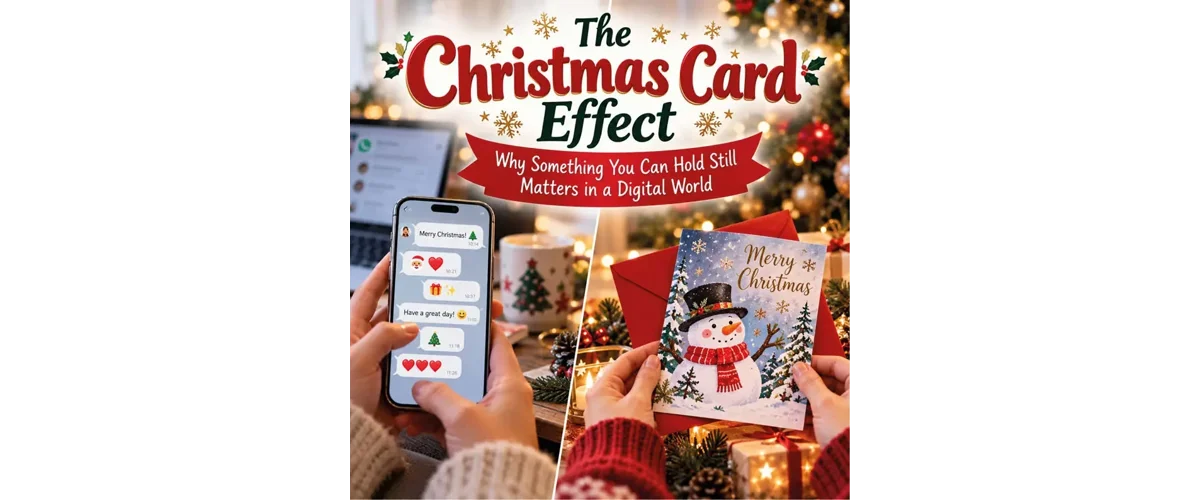
We can send a message to almost anyone in seconds.
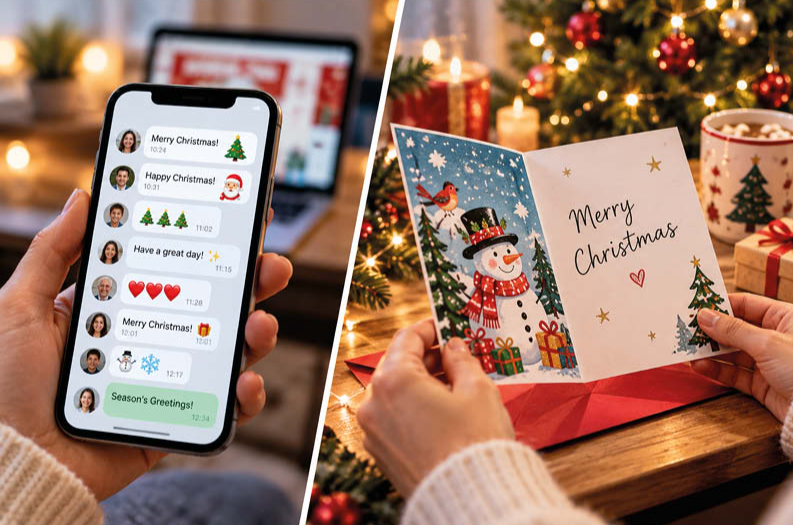
A Christmas greeting can arrive by WhatsApp before we've even put the kettle on. Family photographs appear on social media. Children can send animated snowmen, dancing Santas and digital stickers to their friends. Even the annual family update can now be posted once and seen by everyone.
So, logically, the Christmas card ought to feel a little outdated.
Except it doesn't.
There is still something noticeably different about finding an envelope with your name handwritten on the front. A card has to be chosen, written, addressed and physically given or sent. And perhaps that little bit of inconvenience is exactly what gives it value.
At Christmas, when so much communication is instant, a physical card asks us to slow down.
The Difference Between Receiving a Message and Receiving Something
Think about what happens to most Christmas messages.
We read them.
We reply.
Then they disappear upwards into a conversation containing hundreds of other messages.
A Christmas card behaves differently. It becomes an object.
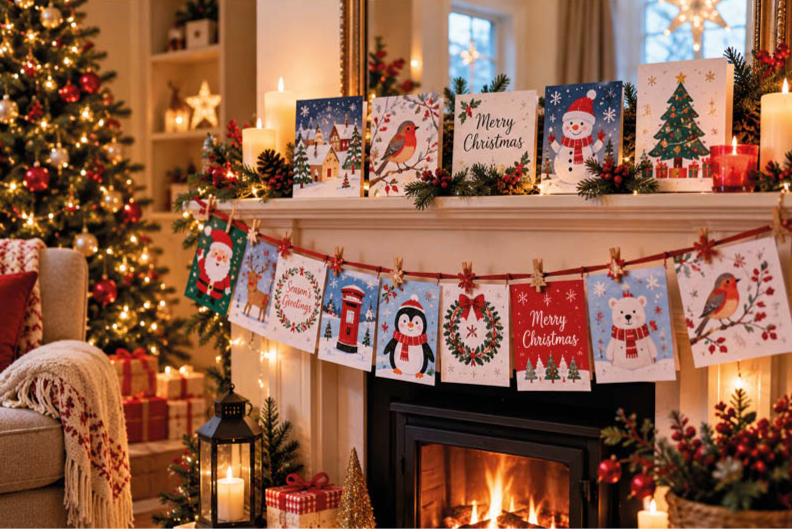
It sits on the mantelpiece, hangs from a Christmas card holder, gets tucked around a mirror or joins a row of cards on a shelf. Suddenly, somebody else's Christmas greeting has become part of your own Christmas decorations.
That's an unusual characteristic when you think about it.
Most communication is designed simply to deliver information. Christmas cards do that too, but then they stick around.
For a few weeks, the people who sent them become physically represented around the home.
And the more cards that arrive, the more noticeable the effect becomes. An empty card holder gradually fills. The mantelpiece gets busier. Door frames become covered.
Christmas correspondence slowly becomes Christmas décor.
Children Understand the Appeal Better Than Anyone
Adults might talk about Christmas cards in terms of thoughtfulness or keeping in touch.
Children tend to have a rather simpler interpretation.
They're exciting.
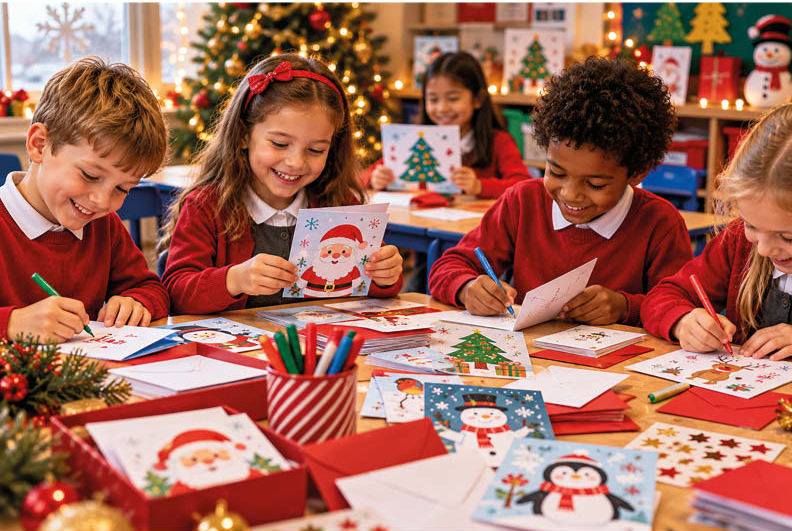
Anyone who has watched primary-school children exchange Christmas cards knows that the attraction isn't merely the message inside.
There's the pile of little envelopes. Finding your name. Discovering who sent one. Choosing which designs go to which friends. Writing thirty names. Deciding who gets the penguin and who gets Santa.
School Christmas card packs turn something adults regard as correspondence into a miniature social event.
And children don't necessarily need expensive cards for that experience. Small cards designed specifically for classmates can make the ritual accessible when one child might want to give cards to an entire class, a teacher and a teaching assistant.
For retailers, schools and PTAs, that makes children's Christmas cards quite different from many other festive products. They aren't simply something children receive.
They're something children give.
Why Making the Card Changes the Gift
Then there's another level entirely.
What happens when the sender has made the card?
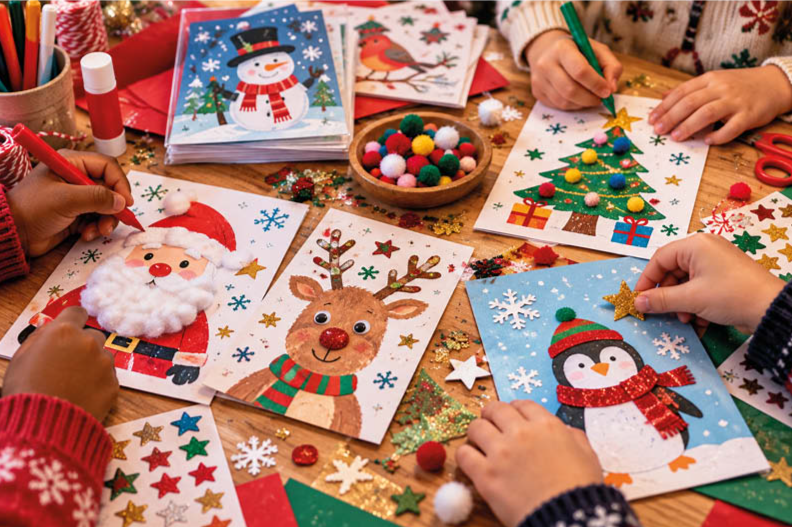
A perfectly printed robin may look beautiful, but the slightly wonky Christmas tree drawn by a six-year-old has something perfection can't reproduce.
That is why colour-your-own and make-your-own Christmas cards sit somewhere between a Christmas card, a craft activity and a present.
The activity is part of the point.
Children have to choose colours, draw, stick, decorate and eventually decide who deserves their creation. The finished result may not be symmetrical. There may be an excessive amount of glitter. Santa's beard may inexplicably be purple.
None of that matters.
In fact, that's rather the appeal.
The imperfections provide evidence that somebody actually spent time making it.
For parents, schools and festive activity sessions, creative Christmas crafts also offer something increasingly valuable: an activity with a finished purpose.
Rather than colouring a picture and forgetting about it, children make something specifically to give away.
The Tiny Decisions That Make a Card Personal
Even when a card isn't handmade, choosing one can become surprisingly personal.
Think about a mixed pack of Christmas cards.
You rarely take the first card from the box and work methodically through your address book.
Instead, certain people somehow become certain cards.
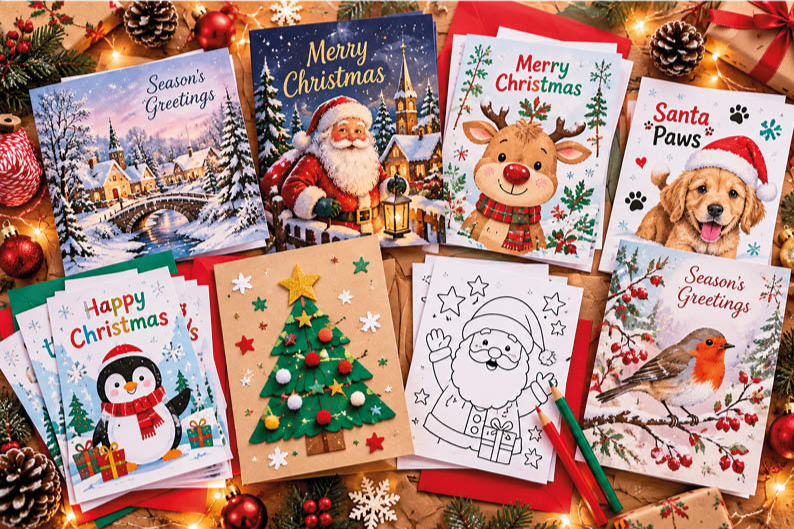
Grandma might get the traditional snowy village.
Your neighbour gets the robin.
The friend who loves dogs gets the Christmas puppy.
Someone else is definitely a Santa.
It is a tiny decision, but that's what makes physical greetings interesting. The sender isn't only choosing to say Merry Christmas. They're choosing how to say it.
Traditional Christmas cards, contemporary festive designs, woodland scenes, children's cards and novelty designs can all communicate essentially the same message while feeling completely different.
That variety matters to retailers too.
One customer may want elegant cards to send to relatives. Another wants inexpensive packs for dozens of friends. Another is buying for children. Someone else wants cards that can double as a festive craft activity.
"Christmas cards" sounds like one product category.
In reality, people are buying them for very different social situations.
The Mantelpiece Is a Very Low-Tech Social Network
There's another curious thing about Christmas cards.
Once displayed, they're public.
Visitors see them. Children count them. Families recognise names. People comment on particularly nice designs.
Long before anyone talked about social networks, the Christmas mantelpiece was quietly doing something similar.
It showed connections.
Not through follower counts or profile photographs, but through a collection of folded pieces of card.
This is where Christmas card holders come into their own. Peg holders, strings and decorative displays turn individual greetings into one large festive feature.
And unlike a digital inbox, the display grows visibly as Christmas approaches.
One card becomes five.
Five becomes twenty.
Soon you're wondering where you're going to put the rest.
Why Physical Things Feel Different in a Digital Christmas
Christmas itself is full of physical rituals that would be terribly inefficient if efficiency were the objective.
We wrap presents only for somebody to tear the paper off.
We decorate trees and take everything down again a few weeks later.
We pull crackers containing paper hats we would never dream of wearing at any other time of year.
We write gift tags even though the recipient is probably sitting three feet away.
Christmas cards fit perfectly into that world.
Their value isn't really about transmitting the words "Merry Christmas". A text message can do that faster, cheaper and with considerably less risk of getting lost behind the radiator.
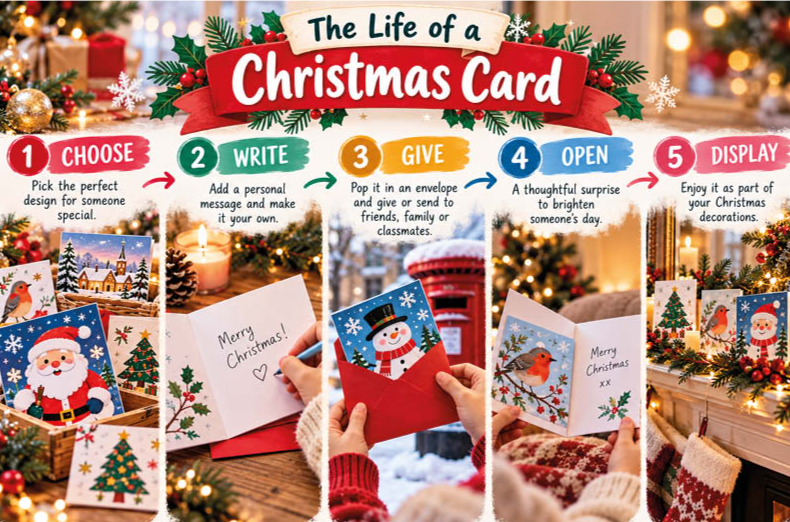
The physical process is part of the experience.
Choosing.
Writing.
Giving.
Opening.
Displaying.
That's why digital communication hasn't necessarily made the Christmas card pointless. In some ways, it has made the physical nature of the card more noticeable.
When almost everything else arrives instantly on a screen, receiving something tangible can feel surprisingly special.
Not Every Card Has to Be Serious
Of course, none of this means Christmas card giving needs to become terribly sentimental.
Sometimes a card is simply fun.
Children enjoy colourful characters. Novelty designs make people smile. A cheerful Santa or winter animal can be chosen simply because somebody likes it.
And for younger children especially, the pleasure may be less about the profound emotional significance of handwritten communication and considerably more about having thirty envelopes to hand out at school.
That's fine too.
Part of the strength of Christmas cards is that they can occupy both worlds.
They can carry a meaningful message to someone you rarely see.
Or they can contain:
"To Jack. Merry Christmas. From Harry."
Both still count.
The £1 Test: What Actually Feels Valuable?
There's an interesting lesson here for anyone selling Christmas products.
Price and perceived value aren't always the same thing.
A relatively inexpensive pack of Christmas cards can create dozens of individual exchanges. A small craft set can occupy a child and produce several gifts. A card holder can become part of the room's Christmas decoration.
Customers aren't always evaluating a festive product purely by how much material they're getting for their money.
They're often buying an experience.
That's particularly relevant to seasonal retail.
The strongest Christmas products frequently have a purpose beyond simply existing. Decorations transform a room. Crafts create an activity. Stocking fillers create surprise. Crackers create a shared moment around the table.
Cards create connection.
Thinking about products this way can be useful when putting together a Christmas range. Rather than asking only What does this cost?, it can be worth asking:
What does somebody actually do with it?
A Christmas Card Has Two Customers
This might be the most unusual thing about the category.
The person buying a Christmas card usually isn't buying it for themselves.
That means every card effectively has two audiences.
The sender has to like it enough to choose it.
The recipient has to enjoy receiving it.
For children's school packs, that equation becomes even more complicated. The parent may buy the pack, the child chooses and writes the cards, and classmates receive them.
With make-your-own cards, the activity itself adds another layer.
With decorative card holders, the recipient becomes the customer again because now they're displaying what everybody else has sent them.
It explains why variety is so useful within a Christmas card range. Traditional designs, children's cards, creative cards and card displays aren't necessarily competing for exactly the same customer.
They're solving different parts of the same Christmas ritual.
Perhaps "Inconvenient" Is Sometimes the Point
We spend most of the year trying to make life quicker.
One-click ordering. Contactless payments. Instant messages. Same-day delivery. Automatic reminders.
And they're useful precisely because they remove effort.
But Christmas is one of those occasions when effort can communicate something too.
A child making a card could have done something quicker.
Someone writing twenty envelopes could have sent one group message.
A friend posting a card could have sent an emoji.
They chose the slower option.
Perhaps that's why Christmas cards have managed to remain relevant alongside phones, messaging apps and social media.
They don't compete particularly well on speed.
They compete on effort, personality and presence.
And sometimes, seeing your name handwritten on an envelope is still rather difficult for a notification to beat.
Explore Wholesale Christmas Cards
At Risus Wholesale, our Christmas Cards collection includes a variety of festive options for retailers, schools and seasonal events, from traditional Christmas card designs and children's school packs to colour-your-own and make-your-own cards.
You can also find Christmas card holders for turning all those festive greetings into part of the Christmas display.
Whether they're being written by children for thirty classmates, sent to family members or displayed around the home, the humble Christmas card still manages to do something remarkably simple:
It turns a message into something you can keep.
Shop Wholesale Christmas Cards