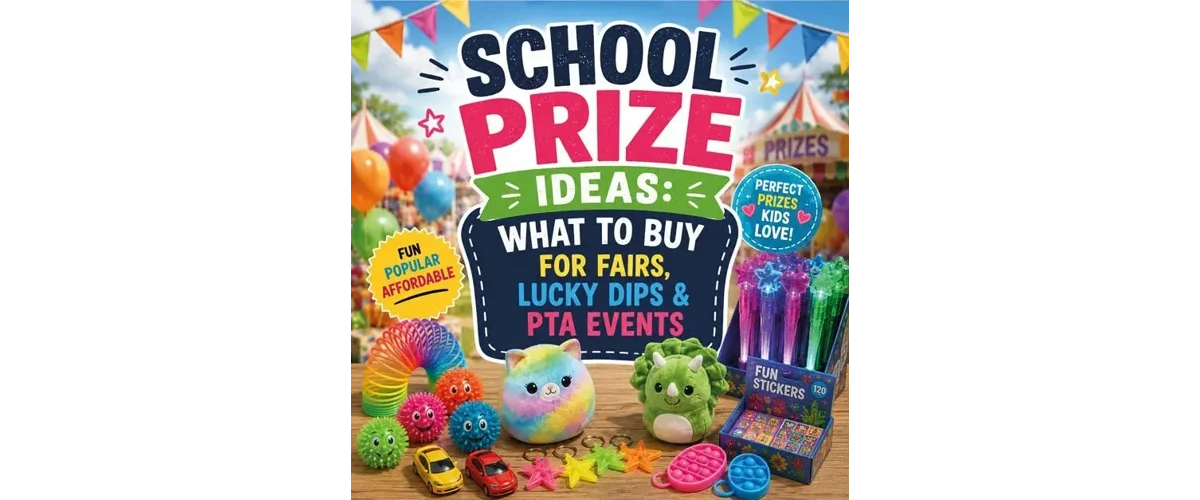
Finding good school prize ideas isn't always as simple as buying the cheapest toys you can find. A great prize needs to appeal to children, suit the activity you're running and, importantly for PTAs, leave enough money behind to make your fundraising worthwhile.
A lucky dip might need hundreds of inexpensive little toys, while a tombola works better with a mixture of prize values. School competitions and reward schemes need something different again.
So what should you buy?
We've put together some practical ideas for choosing PTA prizes, school fair prizes, lucky dip toys and children's fundraising prizes, including what works well, how much to spend and how to avoid ordering far more – or far less – than you actually need.
So, What Actually Makes A Good School Prize?
Ask children and adults this question and you'll probably get very different answers!
Adults naturally look at price and value. Children are much more likely to notice whether something is colourful, squishy, bouncy, funny, collectible or simply something their friends will want too.
That's good news for PTAs because popular school prizes don't necessarily need to be expensive.
Some consistently useful prize choices include:
When you're buying in quantity, even a small difference in unit cost can make a substantial difference to how much your event raises.
Prize Ideas for Different PTA Activities
Lucky Dips
The humble lucky dip is still one of the easiest PTA stalls to organise.
Because every child normally receives something, the ideal lucky dip prizes are inexpensive, small and fun. Having lots of different designs also makes the lucky dip more exciting.
Good options include mini toys, bouncy balls, small fidgets, novelty stationery, erasers, bubbles and stickers.
If you're charging £1 per go, you don't want to discover afterwards that you've accidentally put 70p worth of stock into every parcel!
Children's Tombolas
A tombola is different because not every ticket necessarily wins.
That gives you more freedom to mix inexpensive products with a handful of larger or more desirable tombola prizes for children.
Try creating a varied prize table with toys, games, activity books, fidgets, squishies and perhaps some small plush products.
A few eye-catching prizes displayed prominently can help attract children to the stall even if most of the winning items cost considerably less.
School Fair Games
Hook-a-duck, hoopla, bean bag tosses and other traditional school summer fair games work particularly well with different levels of prizes.
For example:
- Have a go → Small participation prize
- Good score → Standard prize
- Top score → Larger prize
You don't have to use that exact system, of course, but having different prize values gives you much more control over your costs.
School Discos
School discos call for slightly different prizes.
Light-up toys, novelty products, fidgets and small pocket money toys tend to fit the atmosphere better than traditional fair prizes.
If prizes are being used for dancing competitions or party games, you can also afford to offer fewer, slightly higher-value products rather than needing a prize for every child.
Classroom Rewards & School Competitions
Not every prize needs to raise money.
Small toys and gifts are also useful for reading challenges, attendance rewards, sports days, classroom competitions, good behaviour and achievement awards.
Novelty stationery, books, small games and inexpensive toys can work particularly well because children can actually use them afterwards.
How Much Should You Spend On School Prizes?
This deserves its own prominent section because it's probably one of the most useful questions for a PTA buyer.
Rather than starting with a toy and asking "How much should we charge?", work in the opposite direction.
If you're charging £1 per turn and want a healthy proportion of that £1 to contribute towards fundraising, you clearly can't spend 80p on every prize.
As a rough example:
| Charge Per Go |
Example Prize Budget |
| 50p |
10p–15p |
| £1.00 |
20p–30p |
| £1.50 |
30p–45p |
| £2.00 |
40p–60p |
These aren't rules. Some games won't award a prize every time, while others will have additional costs to consider.
The important bit is this:
Decide what you want to raise first. Then work out what you can afford to spend on prizes.
The Secret Is Cost Per Prize – Not Pack Price
Here's an easy mistake to make when comparing bulk school prizes.
Imagine two packs both cost £20.
- Pack A: 100 toys = 20p each
- Pack B: 24 toys = 83p each
They're both £20 packs, but they're completely different propositions for a PTA.
When comparing wholesale prizes, always check the quantity and calculate the individual cost per prize.
For an event requiring several hundred toys, a difference of just 10p per item can quickly turn into £20, £30 or £50 of potential fundraising.
Cheap Prizes Children Actually Want
"Cheap" doesn't have to mean boring.
In fact, some very inexpensive pocket money toys have exactly the characteristics that make good prizes.
Look for:
- Something tactile – squishy, stretchy, poppable or squeezable.
- Something active – bouncing, flying, spinning or throwing.
- Something collectible – several colours, characters or designs.
- Something useful – pencils, pens, erasers, notebooks or books.
- Something silly – novelty toys can punch well above their price when it comes to playground appeal.
That's one reason it's worth choosing a mixture of prize types rather than buying 500 identical toys.
Don't Buy Everything For The Same Age
If you're buying prizes for a whole primary school, remember that Reception and Year 6 can have very different ideas about what's cool!
For younger children, simple toys, bubbles, balls, colouring products and cute novelty items can work well.
Older primary-age children may be more interested in fidgets, sensory toys, games, squishies and novelty stationery.
You don't necessarily need separate prize stocks. A varied selection allows children to gravitate towards whatever appeals to them.
The same applies to boys' and girls' prizes. Wherever possible, concentrate on different interests rather than rigidly dividing your prize table by gender.
How Many Prizes Do You Need?
For an activity where everyone wins, it's simple:
250 expected plays = at least 250 prizes.
For games where only some players win, estimate the win rate instead.
If you expect 300 attempts and roughly one person in three wins:
300 ÷ 3 = approximately 100 prizes.
Then add a sensible buffer.
It's generally better to have a small quantity left over than to run out halfway through a busy event.
And generic leftover prizes rarely need to go to waste. They can be kept for another fair, school disco, Christmas event, classroom reward or future PTA fundraiser.
A Few Prize-Buying Mistakes To Avoid
After all that, here's the quick version.
Avoid buying prizes without calculating the unit cost. Don't spend so much on prizes that there's barely anything left to raise. Don't assume one type of toy will appeal to every age group, and don't leave ordering until the week of your event.
Most importantly, match the prize to the activity.
A 15p toy can be a fantastic lucky dip prize but a disappointing competition winner. Equally, there's little point putting an expensive toy into a game where hundreds of children will win one.
School Prize Buying Checklist
Before placing your order, ask:
- ✓ What are the prizes being used for?
- ✓ How many children are likely to take part?
- ✓ Does everybody win?
- ✓ What's our maximum cost per prize?
- ✓ Have we calculated the individual unit cost?
- ✓ Is there enough variety for different ages?
- ✓ Do we have a mixture of products?
- ✓ Have we allowed some spare stock?
Then you're ready to shop.
Frequently Asked Questions About School Prizes
What are the most popular prizes for school children?
Fidget toys, squishies, bouncy balls, bubbles, novelty toys, stationery, mini games and pocket money toys all make popular school prizes. Having a mixture usually works better than relying on one type of product.
What are good cheap prizes for a lucky dip?
Bouncy balls, stickers, erasers, bubbles, mini toys, novelty stationery and small fidget toys are all useful low-cost lucky dip prizes.
What prizes work well for a school tombola?
Try combining inexpensive toys with some larger prizes. Plush toys, games, books, squishies, fidgets and novelty products can all work well on children's tombola stalls.
How much should PTA prizes cost?
There's no fixed amount. Start with what you're charging for the activity and how much you hope to raise. You can then calculate a sensible maximum cost per prize.
Can schools buy prizes in bulk?
Yes. Buying bulk prizes for schools can significantly reduce the individual cost compared with purchasing toys individually at retail prices.
What can we do with leftover school fair prizes?
Keep them! Generic toys can be reused for school discos, Christmas fairs, classroom rewards, lucky dips, competitions and future PTA fundraising events.
Find The Right Prizes For Your Next School Event
From a few special competition prizes to hundreds of inexpensive lucky dip toys, choosing the right products can help make your event more exciting for children without eating into the money you're trying to raise.
Explore our PTA Prizes & Gifts range for affordable toys, gifts and prizes available in bulk for schools, PTAs and fundraising groups throughout the UK.
Or visit our PTA Buying Zone for more products and ideas for school fundraising events.