


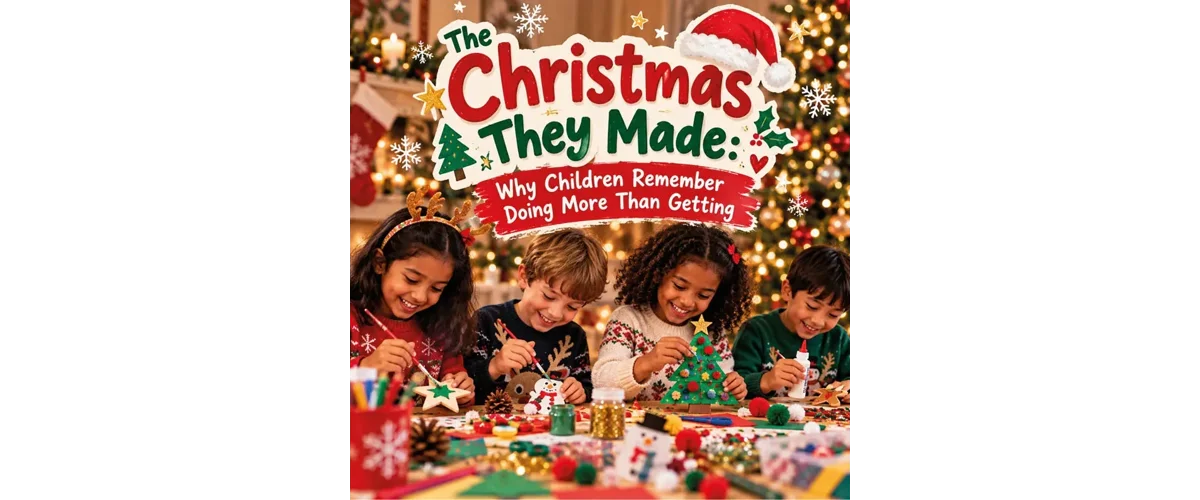
Christmas morning gets most of the attention.
The presents. The stockings. The new toys spread across the living-room floor.
But think back to your own childhood Christmases and something interesting happens. Some of the memories that stick aren't presents at all.
They're things you did.
Making paper chains that were never quite the same length. Cutting out snowflakes. Colouring Christmas pictures. Painting decorations that came out nothing like the picture on the box. Making cards for grandparents. Covering the kitchen table in glue, glitter and tiny scraps of coloured paper.
And, somehow, being incredibly proud of the result.
Perhaps that's why Christmas crafts have survived so well in an age when children have more entertainment available to them than any previous generation.
Because Christmas isn't only something children receive.
It's something they can help to make.

The Weeks Before Christmas Are Part of Christmas
For children, Christmas doesn't begin on 25 December.
It begins weeks earlier.
The decorations start appearing. Christmas songs suddenly seem to be playing everywhere. School rehearsals begin. Advent calendars are opened. Lists are written. Trees go up.
The anticipation is enormous.
And crafts fit beautifully into that period because they turn waiting into doing.
A child colouring a Christmas picture isn't simply passing half an hour. They're participating in the build-up.
Make an advent calendar and you're creating something that becomes part of the countdown itself.
Decorate a Christmas ornament and it might end up on the family tree.
Make paper chains and suddenly part of the room looks Christmassy because you made it that way.
That's quite different from simply being entertained.
The Wonky Decoration Is Usually the One Nobody Throws Away
There is a strange rule about family Christmas decorations.
The expensive matching baubles can come and go.
The slightly battered cardboard reindeer made by a six-year-old somehow survives for 20 years.
Parents keep boxes full of them.
Handprints turned into reindeer. Lopsided snowmen. Stars covered in far too much glitter. Decorations with names written across them in enormous felt-tip pen.
Objectively, they may not be masterpieces.
Emotionally, they're priceless.
That's because a homemade Christmas decoration isn't really just a decoration. It becomes a tiny record of a particular Christmas and a particular age.
Pulling those decorations out each December can become a tradition in itself.
"You made this one when you were four."
And suddenly an afternoon spent painting, colouring or sticking things together has lasted considerably longer than anyone expected.

Christmas Gives Children Permission to Make a Mess
Modern childhood can be surprisingly structured.
School. Clubs. Homework. Screens. Activities. Timetables.
Christmas crafting is refreshingly different.
There doesn't always have to be a right answer.
A Santa can have a purple hat.
A snowman can be covered in sequins.
A Christmas tree can apparently contain every colour ever invented.
Give ten children the same craft kit and you'll often end up with ten completely different results.
That's part of the appeal.
Colouring, painting, scratch art, modelling clay, mosaics, bracelet making and make-your-own decorations all offer slightly different experiences, but the basic idea is the same:
Here are some materials. Now make something.
For younger children especially, the finished result isn't necessarily the important bit.
Choosing the colours, peeling the stickers, squashing the clay, arranging the pieces and proudly announcing "I've finished!" can be the real activity.
And yes, there may be glitter on the carpet until February.
Some Christmas traditions require sacrifice.
From the Classroom to the Kitchen Table
Christmas crafts also have the unusual advantage of working almost anywhere.
At home, they can become a quiet afternoon activity during the increasingly excitable run-up to Christmas.
At school, a simple craft session can fill the classroom with decorations children have made themselves.
At a Christmas fair, a craft table gives children something to do, rather than another stall where they simply buy something or try to win a prize.
At a Christmas party, colouring and activity packs can provide a calmer alternative when not every child wants another energetic game.
At restaurants, family gatherings and Christmas events, small activity sets can keep little hands occupied while the adults attempt to have an uninterrupted conversation for more than 45 seconds.
And because Christmas crafts range from quick colouring activities to projects children can spend much longer making, there's no single way they have to be used.
Sometimes you need an afternoon project.
Sometimes you just need ten peaceful minutes.
Both are perfectly respectable Christmas ambitions.

There's Something Different About Making a Gift
There's another side to Christmas crafting that becomes more important as children get older.
They can make something for somebody else.
For a young child, Christmas is understandably rather focused on receiving.
What did Father Christmas bring?
What's inside the stocking?
Which present has my name on it?
Making a Christmas card, bracelet, ornament or picture changes the direction.
Now they're thinking about somebody else.
Who is this for?
What colours would Grandma like?
Should Dad's Christmas card have a snowman or Father Christmas?
Where should we hide it until Christmas Day?
The monetary value might be tiny.
That isn't really the point.
A handmade gift lets children experience the other half of Christmas: the excitement of giving something and waiting to see somebody open it.
For schools and families, that's a surprisingly lovely thing to encourage.
The Return of the Handmade Christmas
Interestingly, the wider adult world has been moving in much the same direction.
Christmas doesn't have to look perfect anymore.
The carefully coordinated tree still has its place, but so do homemade wreaths, hand-painted signs, personalised decorations, gingerbread houses, paper ornaments and craft evenings.
People increasingly like Christmas decorations that tell a story.
Children's crafts fit naturally into that kind of home.
A tree decorated entirely by an interior designer might photograph beautifully.
A tree containing a foam snowman, three questionable-looking reindeer and a glitter-covered star made at school in 2019 tells you something about the people who live there.
Perhaps that's why handmade Christmases often feel warmer.
They're personal.

The Christmas Craft Cupboard
Anyone responsible for entertaining several children over Christmas eventually discovers the value of having activities ready.
It doesn't need to be elaborate.
A useful festive craft cupboard might contain a mixture of:
- Colouring books and activity packs
- Crayons, pens and pencils
- Stickers and sticker activities
- Painting projects
- Air-dry clay or modelling activities
- Scratch art
- Make-your-own decorations
- Mosaic crafts
- Paper chains and bunting
- Jewellery and bracelet-making kits
- Christmas cards and pictures to decorate
- Advent and countdown crafts
The variety matters because children don't all enjoy the same thing.
One child may happily colour for an hour.
Another wants to build something.
Another wants paint.
Another has spotted the glitter and is already beyond your control.
For retailers, schools, PTAs and event organisers, that variety is useful too. Christmas craft products can be anything from inexpensive little activities and stocking fillers to more substantial creative gifts. Risus Wholesale's current Christmas craft range spans colouring and painting through to clay, activity packs, make-your-own decorations, paper chains, bunting, mosaics and other creative projects.

Screens Aren't the Enemy
It's tempting to turn any discussion about children's crafts into screens versus traditional play.
That probably misses the point.
Children live in a digital world. They watch films, play games, use tablets and enjoy technology.
Christmas crafts don't need to compete with that.
They're simply a different kind of experience.
A screen can show you somebody making a snowman.
Clay lets you make one.
A video can show a beautifully decorated Christmas tree.
A craft kit lets you create something that actually hangs on yours.
One is consumption.
The other is participation.
Christmas has room for both.
In fact, that change of pace may be exactly why a simple colouring book, box of crayons or make-your-own kit can still feel surprisingly appealing.
Don't Make It Too Perfect
Adults have a habit of interfering with children's crafts.
We straighten things.
We suggest better colours.
We move the sticker two centimetres to the left.
We quietly correct the snowman's face when nobody is looking.
Resist.
If a four-year-old believes Father Christmas needs green trousers and six buttons, Father Christmas can have green trousers and six buttons.
The charm is in the fact that they made it.
The same applies to school craft tables and Christmas events. A successful activity doesn't need 30 children to produce 30 identical decorations.
Quite the opposite.
The fun is seeing what happens when everybody starts with roughly the same materials and finishes somewhere completely different.

What Children Actually Take Away From It
Most Christmas crafts eventually disappear.
The colouring book gets filled.
The clay dries out.
The stickers get used.
The paper chains come down in January.
Some particularly beloved creations survive in the loft and make an annual comeback.
But the physical thing was never necessarily the most important part.
It was sitting around the table together.
It was choosing what to make.
It was the excitement of creating a decoration for the tree.
It was secretly making something for Mum.
It was the school classroom gradually filling with paper snowflakes.
It was being allowed to use far too much glitter.
Those are tiny experiences.
Christmas is largely made from tiny experiences.
Let Them Make Christmas
We spend a lot of time trying to create Christmas for children.
We decorate the house.
Buy the presents.
Fill the stockings.
Arrange the parties.
Plan the school fairs.
Book the grottos.
Hide the presents.
Move the elf.
And then move the elf again because we forgot the night before.
But perhaps children don't always need Christmas presented to them fully finished.
Give them some paper.
Give them some paint.
Give them stickers, crayons, clay, ribbon, glitter and something they're allowed to cover with all of the above.
Then let them contribute.
The result probably won't match the Christmas decorations on Instagram.
It might be better.
Because years from now, nobody is going to remember whether every bauble on the tree matched.
But somebody might still pull a battered little decoration out of a box and say:
"I made this."
And that is a pretty good Christmas tradition to keep.
Discover More Christmas Ideas at Risus Wholesale
Whether you're planning a school Christmas fair, stocking a festive shop or organising activities for children, explore our Christmas ranges for more inspiration.
Shop Christmas Wholesale Products →


