There are some things we do at Christmas because they make perfect sense.
We give presents because people like presents. We eat far too much because Christmas dinner is delicious. We decorate our homes because, in the middle of a dark British winter, a few thousand fairy lights make everything look considerably better.
And then there are Christmas crackers.
Think about the ritual for a moment.
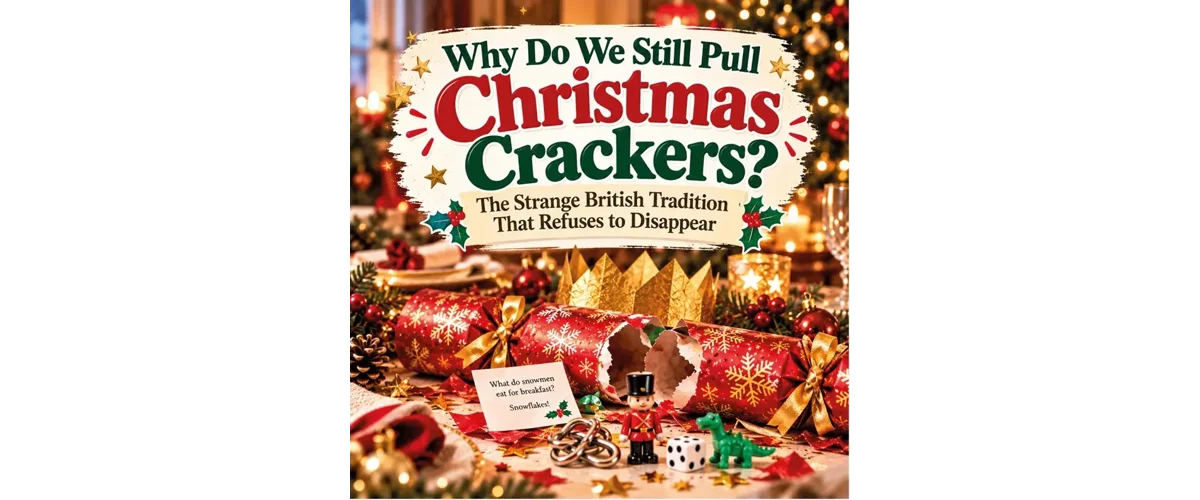
Two people grab opposite ends of a brightly wrapped cardboard tube and pull until it explodes. Everyone checks who has won the contents. Somebody puts on a flimsy paper crown. A tiny plastic object appears. Then, at some point during dinner, somebody reads aloud a joke that would be rejected by almost every professional comedian in Britain.
And we absolutely love it.
For generations, Christmas crackers have occupied a strangely secure position on the British Christmas dinner table. Styles have changed, gifts have changed and the designs have moved with the times, but the basic ritual has proved remarkably difficult to dislodge.
So how did this peculiar tradition become part of Christmas – and why are we still doing it?
It Started With a Sweet
The story usually begins with Victorian confectioner Tom Smith.
During the 1840s, Smith was reportedly inspired by French bonbons – sweets wrapped attractively in twists of paper. He began selling his own versions in Britain, eventually adding little messages inside the wrapping.
That alone wasn't enough.
Smith wanted something that would make his product more exciting and memorable.
The crucial development was the addition of a small explosive strip which produced a bang when the wrapper was pulled apart.
The cracker was born.
The precise story has acquired its share of Christmas mythology over the years, but what emerged during the Victorian period was an ingenious combination: packaging, surprise, theatre and a gift all contained within one object.
It was more than a sweet.
It was something you did.
That may be the secret to everything that happened next.
Christmas Is Built on Ritual
Consider how many Christmas traditions involve repeating exactly the same behaviour every year.
We hang stockings.
We decorate a tree.
We leave something out for Father Christmas.
We open doors on advent calendars.
We sing songs most of us wouldn't dream of singing in February.
Traditions become powerful partly because they're repeated. The action itself starts to signal that something special is happening.
Pulling crackers works in much the same way.
A Christmas table can contain exactly the same plates, glasses and cutlery you use throughout the year. Put a cracker beside every place setting and suddenly it unmistakably looks like Christmas.
That's an impressive achievement for a cardboard tube.
The cracker has effectively become a visual shorthand for the beginning of Christmas dinner.
The Bang Matters More Than You Might Think
There's also something wonderfully theatrical about a cracker.
Everyone knows what's going to happen.
Everyone knows it's going to make a bang.
Yet there's still a tiny moment of anticipation immediately before it does.
Psychologists sometimes describe the enjoyment we get from predictable rituals as partly coming from anticipation. Knowing roughly what will happen doesn't necessarily spoil an experience; sometimes it makes participating in it more enjoyable.
A cracker adds a miniature event to the meal.
There's the negotiation over who pulls with whom.
The countdown.
The snap.
The brief competition to see who ended up holding the larger half.
Then the investigation of whatever has fallen onto the table.
All of this might take twenty seconds.
But twenty seconds multiplied around a table creates noise, laughter and interaction.
The cracker isn't really a decoration.
It's a social device disguised as one.
And Then There Is the Paper Hat
Of all the objects contained inside a Christmas cracker, perhaps the strangest is the paper crown.
At almost any other time of year, convincing an entire table of adults to wear brightly coloured tissue-paper hats throughout dinner would be difficult.
At Christmas, nobody questions it.
Grandad wears one.
The children wear them.
Your extremely serious uncle wears one.
Someone inevitably tears theirs while trying to put it on.
Someone else wears theirs at an angle for the next three hours.
The origins of cracker crowns are often linked with festive headwear and older traditions surrounding celebrations and feasts. Whatever their precise route into the modern cracker, they've become almost inseparable from the experience.
And they demonstrate something important about Christmas.
Christmas gives adults permission to be slightly ridiculous.
The paper crown works because everybody is ridiculous together.
Why Are Cracker Jokes So Terrible?
Then comes the joke.
What do snowmen eat for breakfast?
Snowflakes.
You probably groaned.
Which means the joke has done its job perfectly.
Christmas cracker jokes occupy a strange category of comedy where being genuinely funny isn't necessarily the objective.
In fact, an extremely clever joke might somehow feel wrong.
The classic cracker joke is short, harmless, understandable by almost everyone around the table and – ideally – followed by a collective groan.
That's important.
A family Christmas dinner might contain a five-year-old, a teenager, parents and grandparents. Finding entertainment that works simultaneously for everyone isn't easy.
A silly joke requires almost nothing from its audience.
Even complaining about how awful it is becomes part of the entertainment.
Perhaps the real Christmas cracker joke isn't the joke itself.
It's watching Dad insist on reading all six of them.
From Trinkets to Games
The contents of crackers haven't stood still either.
The familiar miniature novelty gift remains part of the tradition, but manufacturers have experimented endlessly with what can fit inside that cardboard tube.
Depending on the cracker, you might now find puzzles, characters, small games or pieces which combine with the contents of the other crackers around the table.
That's a clever evolution.
Instead of six people receiving six unrelated objects, the crackers can become the beginning of another shared activity.
Game crackers take something that was already social and extend it beyond the initial pull.
It also reflects a wider change in what people expect from Christmas products.
The experience increasingly matters as much as the object.
Crackers Learned to Change Their Clothes
Walk down a Christmas aisle today and you'll notice something else.
The cracker itself has become part of Christmas styling.
Traditional red, green and gold designs still exist, but they're joined by kraft paper, metallic finishes, contemporary patterns, children's characters, novelty themes and designs intended to coordinate with particular Christmas table settings.
This is one reason the cracker has survived so effectively.
The ritual has remained recognisable while the appearance has continually changed.
A Victorian Christmas cracker and a modern one might look completely different on the outside, yet somebody from either era would understand the basic idea.
That's quite unusual.
Most products have to choose between tradition and reinvention.
Christmas crackers somehow manage both.
For retailers, that also means crackers can appeal to very different customers. Someone creating an understated natural Christmas table may choose something completely different from a family looking for colourful children's crackers.
The function is identical.
The personality isn't.
Children's Crackers Changed the Audience
For children, crackers have an additional advantage.
They're presents that you're actively encouraged to explode before opening.
That's difficult for conventional gift wrapping to compete with.
Children's Christmas crackers have increasingly embraced brighter designs, familiar characters and contents aimed specifically at younger diners.
It makes sense.
Christmas dinner is largely designed by adults, cooked by adults and – depending on the household – can last considerably longer than most children would choose.
A cracker gives children something at the table that belongs specifically to the fun part of the day.
Character designs also demonstrate how adaptable the format has become.
The Victorian cracker didn't disappear when children's tastes changed.
It simply changed with them.
Making Your Own Brings the Story Full Circle
Perhaps one of the most interesting modern variations is the make-your-own Christmas cracker.
In some ways, it takes the product back towards its origins.
Instead of buying a completely predetermined cracker, families can choose what goes inside.
A personal message.
A favourite sweet.
A small present.
A deliberately dreadful family joke.
Something meaningful to the person sitting at that particular place setting.
There's also a creative element. Making and decorating crackers can become a Christmas activity in its own right, particularly with children. It's part of the same appeal that makes Christmas crafts for children such an enduring part of the festive season.
In an age when so many Christmas products arrive completely finished, there's something appealing about leaving part of the experience for the customer to create.
And personalised crackers solve one of the oldest cracker problems of all:
Nobody has to wonder what they're supposed to do with another miniature plastic comb.
The Perfect Christmas Product Might Be an Experience
The longevity of Christmas crackers offers an interesting lesson about why certain traditions survive.
It probably isn't because we desperately need the contents.
It's because a cracker combines several things humans rather like:
anticipation + surprise + noise + humour + participation + tradition.
And it manages to deliver all of them in less than a minute.
The physical product is almost secondary.
Ask somebody about crackers from a childhood Christmas and they're unlikely to remember the precise novelty they received.
They might remember everyone pulling them.
They might remember wearing the hats.
They might remember their grandmother reading the jokes.
They remember the experience surrounding the object.
That's a powerful quality for something that begins life as a small cardboard tube.
Nearly Two Centuries Later, We're Still Pulling
Christmas has changed enormously since the Victorian period.
Our presents have changed.
Our Christmas decorations have changed.
Our entertainment has changed.
Even Christmas shopping has moved from crowded high streets to phones and laptops.
Yet put a cracker beside every plate on Christmas Day and almost everybody knows exactly what happens next.
Someone crosses their arms to pull crackers with the people on either side.
Someone warns everybody about the bang.
Someone's cracker doesn't snap properly.
Someone immediately puts the crown on.
And somebody reads:
What do you call an elf wearing earmuffs?
Anything you like. He can't hear you.
Terrible.
Exactly as it should be.
Perhaps that's why Christmas crackers have survived.
They were never really about what was inside them.
They were about what happened around the table.
Find Your Christmas Crackers
From traditional festive designs and children's favourites to novelty, character and game crackers, there's now a Christmas cracker to suit almost every style of celebration.
Browse our Wholesale Christmas Crackers range for festive table crackers in wholesale quantities, or explore our wider Christmas Wholesale collection for toys, gifts, decorations, crafts and other seasonal essentials.